

- This event has passed.
Abr Kyā Chīz Hai / What Really is a Cloud? – Art Exhibition
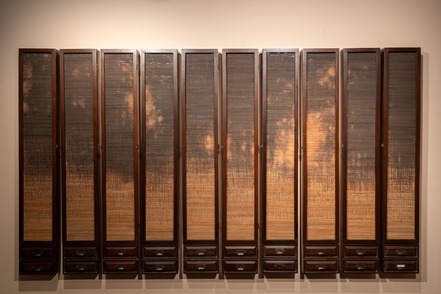
Akar Prakar Presents Abr Kyā Chīz Hai / What Really is a Cloud? – Recent Works by Debasish Mukherjee
Curatorial Advisor: Ranjit Hoskote
About the Exhibition
Abr Kyā Chīz Hai/ What Really is a Cloud? takes its title from Mirza Ghalib’s evocative verse, echoing enduring questions about place, time, and the unseen forces that shape human experience. Rather than offering answers, the exhibition sustains a lingering inquiry into memory, perception, and the fragile architectures of belonging.
Over the years, memory, space, and displacement have remained central to Mukherjee’s artistic practice. Much of his work draws from the city of Benares and its people, particularly members of his mother’s family who lived there for generations. Benares, with its dense layering of ritual, belief, and continuity, shaped his early consciousness. Along with Chapra, where he spent his childhood, it formed the emotional and cultural bedrock of his thinking.
The artist often divides his life into two chapters. The first encompasses his childhood and formative years in Chapra and Benares. The second began in 1994, when he moved to Delhi. This latter chapter now spanning over three decades constitutes the larger part of his life and is marked by deep personal and professional transformation.

The current body of work emerged from a deeply personal realization. In recent years, Mukherjee noticed a growing difficulty in recalling the names and faces of people he met, even those encountered recently, while older memories remained vivid and sharply detailed. This imbalance between remembering and forgetting became the catalyst for the work, creating an urgency to document, recall, and gather fragments of a life that might otherwise slowly erode. As part of this process, Mukherjee began with writing & recording events from the past thirty years in various formats, noting people, conversations, encounters, and moments that shaped his thinking. Gradually, patterns surfaced, revealing how these interactions had enriched his journey and quietly informed his choices. The act of remembering and recording became both method and material.
While reflecting on objects that could symbolise his early years in Delhi and continue to remain relevant today, the telephone emerged as a recurring element. Mukherjee encountered it meaningfully only after moving to the city. Over the years, it carried innumerable conversations across fragile lines of connection. Before the era of smartphones and digital archives, conversations disappeared the moment a call ended, leaving behind only memory. Friendships were formed, collaborations initiated, relationships sustained, and sometimes lost through this medium. The telephone thus became more than an object, it became a witness, a keeper of voices, and a delicate archive of fleeting human bonds.
Delhi itself functions as a powerful anchor within this body of work. With a population exceeding twenty million and a history spanning over a thousand years, the city exists as a palimpsest of time. Its layered histories, cultural depth, and contradictions offered the artist not just a place to work, but a vast reservoir of memory. The writings of Mirza Ghalib resonated differently once Mukherjee began living in Delhi, particularly through visits to Ghalib’s haveli, where history felt intimately present.
Politics in Delhi is unavoidable and omnipresent. As the seat of power, the city attracts political ambition from across the country. From student politics and university elections to demonstrations and parliamentary debates, political activity is loud, visible, and performative. One of the works in this exhibition responds directly to this charged atmosphere.
Environmental concerns form another critical layer. Delhi is consistently ranked among the most polluted cities in the world. While sustainability has become a widely circulated term, it often functions as a token gesture rather than a deeply integrated practice. A short four-minute film within the exhibition reflects on this contradiction, questioning the gap between rhetoric and action.
Mukherjee’s professional journey is also closely tied to Delhi. Beginning his career in a fashion house soon after moving to the city, he witnessed the Indian fashion industry evolve over three decades. The work Sunadari is an abstract mapping of this transformation, examining the relationship between fashion, aspiration, visibility, and media.
This exhibition functions as a visual and conceptual journal of the artist’s journey emerging from the fear of forgetting but anchored in the joy of remembering. It reflects on his years in Delhi, the weight of its history, its contradictions, and the many people who offered support, inspiration, and resilience along the way. Ultimately, it is about memory in all its fragility and endurance, about what it means to hold on, to let go, and to belong.
Title: Abr Kyā Chīz Hai? / What Really is a Cloud?
Artist: Debasish Mukherjee
Exhibition Dates: 4th February – 6th March 2026
Venue: Akar Prakar, New Delhi
- To list your events with us please email us at info(AT)delhi-fun-dos.com
- We would love to cover and promote your events via our blog and social media channels. If you like us to attend your event, drop us an email at info(AT)delhi-fun-dos.com
- All the event details have been collected either from search engines or from event websites. Kindly check the event website to confirm a date, time, and venue details before going. If an event is canceled or postponed, Delhi-Fun-Dos.com does not take any guarantee or to be held responsible.