
Goa is a land of the sun and the sea. It is home to some of the most popular beaches in the world, and it is quite likely that you have visited some of them. But are you aware that there is so much more to do in Goa?
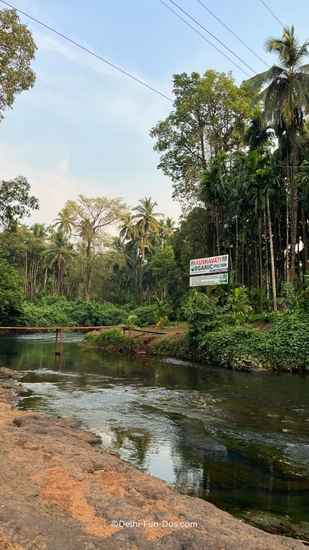
Beach tourism in Goa is the tip of the iceberg as we just discovered. We were fortunate that during our recent visit to Goa, we experienced a side of the state that was unfamiliar but drew us in with its history, traditions and local life. From rock engravings and temples to waterfalls, village art and weaving traditions, there is much to explore beyond the usual tourist circuit.
PIN IT FOR LATER READ
Here is our series of guides to offbeat Goa. If it inspires you to plan your next trip, we hope you will thank us!
Contents
Buddhist Caves at Rivona
Location: Rivona village, Sanguem Taluka, South Goa.
We had seen remnants of a grand Buddha statue at the Goa Museum, which identified Rivona as the source. We were not aware of the presence of Buddhism in this part of India and we had to visit Rivona to explore this angle. The signboards in this area guided us to the site and our taxi dropped us virtually at the door step, or more precisely speaking, above the roof of the cave. The surface was lush green and surrounded by residential houses and we could have never imagined we were at the right spot. But then we spotted a flight of stairs that went down and we were at the wide entry of a huge cave.
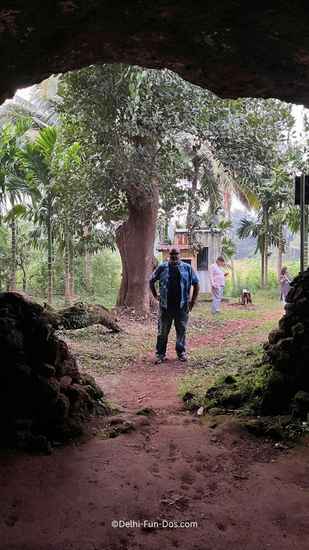
The caves had barely any design but we could spot niches with empty pedestals. We suspect these were the original homes of the giant Buddha statues we saw at the Museum. It was indeed a goose bump moment, more since we knew next to nothing about Buddhist traditions of this region. Given the stark look, we imagine these could be resting places or meditation homes of Buddhist monks who would often travel from one place to another. At the side of this cave, there was also another entry perhaps to a tunnel. We would have explored that section also, but unfortunately, that was closed to visitors.
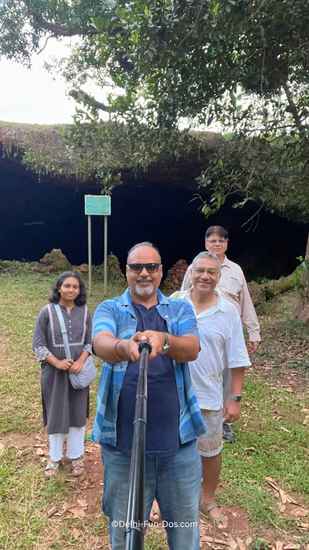
Nonetheless, the cave that we saw was nothing less than a surprise and gave a different meaning to our Goa sojourn. Saving the best for the last, a visit to Rivona can be combined with the unusual rock engravings at Usgalimal. Ask local residents for directions and information about access before planning the visit.
Usgalimal Rock Art
Location: Usgalimal, near Rivona, South Goa.
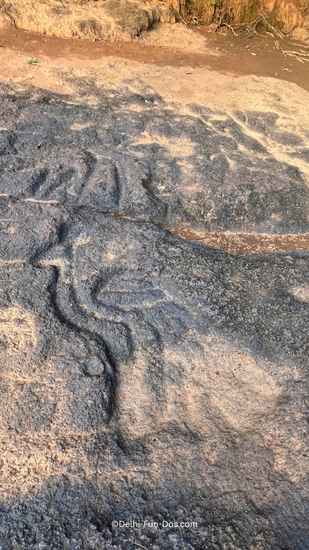
Did you have any idea that Goa has prehistoric sites dating back to Neolithic times, 4000 – 6000 years ago? The quirky rock engravings in Rivona, on the banks of the Kushavati River are like the inscriptions of a post-modernist sculptor. These carvings offer a glimpse into its early past, the lives and beliefs of the people in that era.
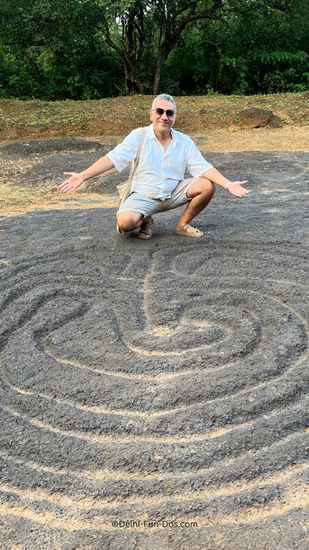
Our first reaction was awe. We saw the carvings but found it challenging to identify the designs. Thankfully the guard helped us to see the shapes by pouring water on the carvings. And almost like magic, the forms appeared as if they were sketched live in front of our eyes. We could then identify deer, boars, elephants and peacocks, along with abstract animal figures and the famous spiral motif. There was also a human figure in a dance pose. The patterns reminded us of Bhimbetka Cave paintings, albeit in Rivona, these were floor carvings and not wall paintings. The futurist designs somehow connect the flow of creativity over generations and into the coming times. The spiral motif still picks our brains as we keep wondering whether it was some sort of a game played by those ancient dudes.
There is not much signage for the Goa Petroglyphs and the area is mostly desolate. It took us some walking around and yet we could not find the way. However, after all this travel, we could not return without viewing the rock arts. Fortunately we found a local man emerging from the forests on a bicycle. Like a messiah, he gave us accurate directions and we could see that this place is easily navigable by a vehicle which could be parked maybe 50 metres away from the site. There was no other tourist and we were standing, just us, in a prehistoric era. If you are looking for a different kind of honeymoon where it is just you and no one else, we would highly recommend the Goa Rock Art.
Also Read: Rock Arts of Purulia in West Bengal
Where to stay
Goa is one of the most popular tourist destinations across the globe. Needless to say, it would offer all possible temporary accommodation options starting from hotels and resorts to guesthouses, paying guests and homestays. Also, Goa is a vast state, and contrary to popular perception, reaching from one place to another may take hours. In our exploration of offbeat Goa, we visited many remote areas with not many hotels or resorts. Depending on our activities, we shacked up at different homestays during our trip.
In fact, Goa Beyond Beaches and rural homestay tourism initiatives are being promoted by Goa Tourism and Goa State Rural Livelihood Mission to drive travel into the heart of Goa’s countryside. The homestay program by SEWA and Airbnb focus on empowering local communities, preserving traditional heritage, and offering travellers authentic cultural immersions through rural homestays run by women across Goa.
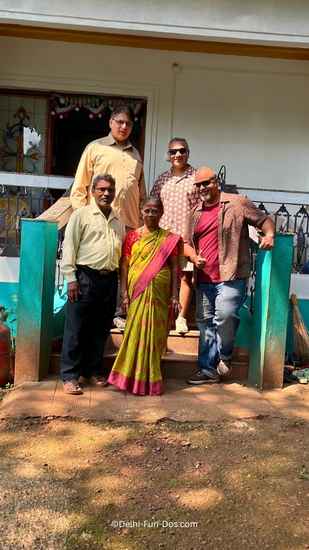
For visiting the Usgalimal Rock Art site and the Buddhist Caves, we lodged at Rushivan Homestay, a member of the homestay promotion initiative. Hosted by Kush Bhai and his wife, we had the most elaborate dinner with an array of Goan specialities like Rawa fish fry, Rawa coated fried chicken, dal, coconut milk based curries, rice and roti, salads and semolina kheer dessert.
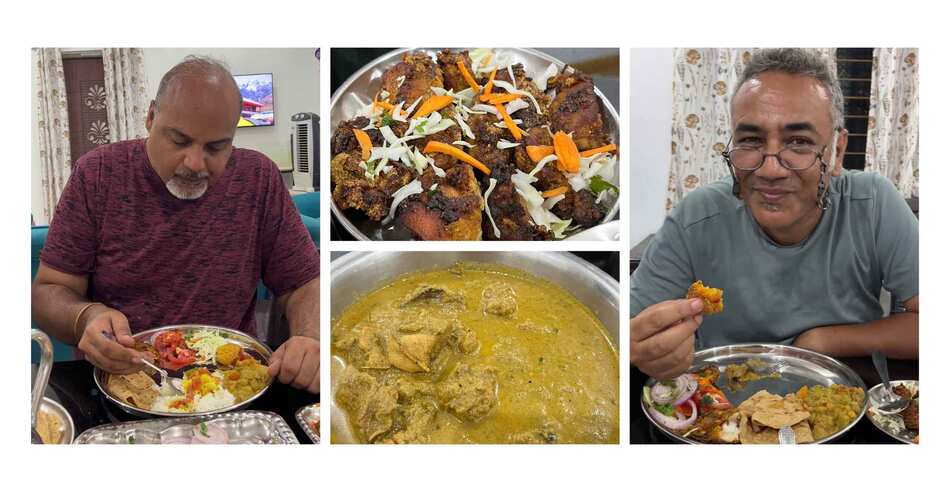
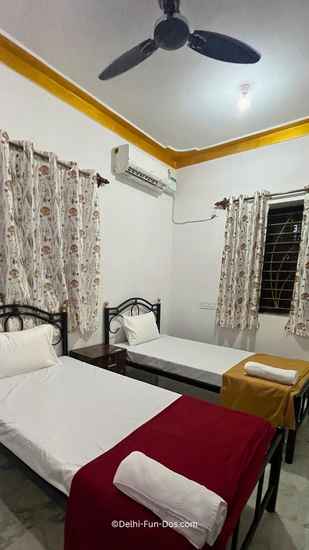
The rooms were comfortable with air-conditioning and geyser and we were also served tea and breakfast. They are located approximately 6 to 7 km from the Buddhist Caves and hence it was the most suitable place to shack up for the night after the long day. Rushivan was surrounded by lush greenery and we got a chance here to unwind during our whirlwind trip.
How to Reach Rushivan Homestay, Rivona
Location: Mattisada, Rivona, Sanguem, South Goa – 403705.
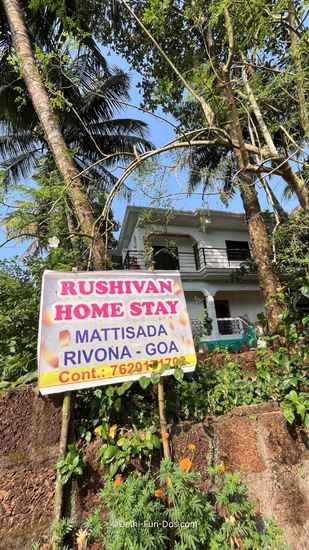
Rushivan Homestay is located Mattisada, Rivona, Sanguem, a village in the hinterland of South Goa, about 21 km from Margao. The journey took us through the villages and countryside of Goa, offering a glimpse of life beyond the coastal tourist circuit.
By Air: The nearest airport is Goa International Airport at Dabolim, approximately 45–50 km from Rivona. From the airport, you can hire a taxi or arrange a pickup with the homestay. The journey takes around 1.5 hours, depending on traffic and the route.
By Rail: Margao Railway Station, also known as Madgaon Junction, is the most convenient railway station for reaching Rivona. It is approximately 20–25 km away. You can hire a taxi from the station or take a bus towards Rivona from Margao’s Kadamba Transport Corporation bus stand.
By Road: Rivona is accessible by road from Margao, which is well connected to other parts of Goa. We recommend contacting the hosts for the final directions as local roads may require additional guidance regarding blockades, repairs etc.
Our visit to Rivona showed us a different side of Goa, with its Buddhist caves, ancient rock art and warm village hospitality. Staying at Rushivan Homestay let us explore at our own pace and enjoy some lovely local food. If you are visiting Goa, set aside a day or two to discover Rivona and see where history takes you rather unexpectedly.
P.S.: Our trip was in collaboration with Goa Tourism, Airbnb and Goa State Rural Livelihood Mission (SRLM).

0 Comments