
Indian art is said to be a function of art in life, but we recently immersed in an art form that was not only art in life, but also art from life. A recent trip to the Warli art villages of Ganjad and Bapugaon in Palghar, Maharashtra, reminded us that Warli it is not just a folk handicraft. It is a living heritage; a people’s story painted in mud and rice-paste but progressing with time.

Warli is no longer just ritual or seasonal art: it has become a medium for expressing identity in changing times, bridging past and present.
As we look forward to Handicraft Week 2025 in Delhi (8–14 December), celebrating the craftsmanship of all corners of India, our journey to the heartland of Warli painting feels especially relevant.
Contents
Earliest Warli Painting

The roots of Warli painting are ancient. The Warli art form dates back to at least as early as the 10th century as a wall painting practice. The earliest forms were not on canvases or papers, but directly on the earthen walls of tribal huts. The process was entirely organic. The walls were coated with red mud or ochre or with a cow-dung mud base. A rice flour paste was used to paint on this surface. Simple sticks, mostly chewed bamboo or reed, were made for brushes. These early paintings were deeply intertwined with life: births, marriages, harvests, and local festivals. Like the Ajanta caves, the walls of homes became living galleries.
PIN IT FOR LATER READ

Religious and Spiritual Warli Themes
For the Warli community, art was not separate from ritual — it was ritual. Through these images, the tribe connected intimately with nature, fertility, and the rhythms of existence. On auspicious occasions such as weddings, special paintings were created in the bedchamber of newlyweds. These paintings, we saw, were mostly a square or a “Chauk” with a fifth corner like a roof. Inside this square, symbols of deities, representations of prosperity, and celestial symbols like the sun and the moon would be painted, along with repeated geometric motifs. Circular shapes in the paintings are also connected with the circle of life. These compositions expressed prayers, hopes, and a spiritual wish for a prosperous life.
Music and Dance Theme

One of the most enduring and recognisable motifs of Warli art is the communal dance, often depicted as a circle of stylised human figures dancing around a musician playing the traditional wind instrument (tarpa). In such paintings, the dance is not just a performance; it embodies community, belonging, shared joy, and the circular continuity of life.

We were fortunate to watch a few of the local folk dances live, and one of those was on a seaside beach! We could totally connect with the joi-de-vivre depicted in the paintings.
Agricultural Theme
Warli art also reflects the community’s livelihood rooted in land, agriculture, and the seasons; their art naturally reflects that. Many paintings show scenes of sowing and harvesting, cattle grazing, gathering wood, and tending crops. Trees, paddy crops, birds, and animals appear, often repeated in rhythmic patterns that echo daily life. Such repetitions create a meditative calm, a sense of continuity, rootedness in the earth’s cycles.
Modern Theme – Warli in Contemporary Context
Warli art, we realised, is not stuck in a time warp. While tribes have moved on from hunting and gathering days, so has their art. During our visit to Ganjad and Bapugaon, what struck us most was how alive and adaptable the Warli remain. We saw works where traditional motifs such as human figures, trees, huts coexisted with modern symbols like cars, trucks and aeroplanes.

The shifting reality of indigenous life is best illustrated in this one painting, depicting how the internet, characterised by a spider web, has drawn and captured all of us in its net from the plains to the mountains. Puritans may hold a differing view, but in our opinion, such paintings are not a dilution of the original form but adaptability, the quintessential spirit needed to survive.
Modern Adaptation of Warli Art
The transformation of Warli from mud-walls to canvases, from ritual-rooms to galleries, has been gradual but profound. While some artists still preserve traditional techniques with mud-ochre backgrounds, rice-paste white pigment, bamboo-stick brushes, many now use modern materials such as canvas, paper, hair brushes and acrylic paints. This ensures durability, transferability, and wider appeal. Artists, many of whom are descendants or disciples of earlier masters, are now creating canvases, paintings on paper, home-decoration items, and even functional crafts. Beyond paintings, Warli motifs now decorate clothes, bags, lampshades, home-decor panels and reach global markets.

Along with modern material, fresh styles of painting have also emerged. Not only in the agriculture-themed pieces, but even otherwise, we found repetition of a pattern a common practice in today’s paintings. Broad blocks on canvas with repeated paintings of paddy or fish, or humans, not only emphasised the chief idea but also created a soothing impact on the eyes. This style had a contemporary appeal and allowed the viewer mind-space to absorb the piece better.

The simplistic form of Warli has enamoured aficionados everywhere. We were recently visited the Statue of Unity in Ektanagar, Gujarat. We were very excited to see Warli paintings on the tree bases of their horticulture park. No wonder, many Warli painters from Ganjad and Bapugaon routinely travel to art schools, museums and culture festivals and hold classes and workshops world over. Warli, therefore, is a precious Intangible Cultural Heritage that, irrespective of its antiquity, is still going strong.
Nevertheless, in many villages of this region, one can still find artisans working in traditional ways, drawing on a red earth base with rice powder paste, with a soaked reed acting as the pencil or the brush. To see the ancient craft preserved is reassuring.
How Is Warli Art Different From Other Art Forms?
What sets Warli apart from many folk or tribal arts is its minimalism which appeals to people beyond boundaries. Instead of realistic figures, ornate decoration or vivid colour palettes, Warli relies on basic geometric forms, circles, triangles, and squares. Moreover, a restrained palette of white on an earthy mud background. We could not see a Warli painting with any other colour but white.

The human forms are simple: two inverted triangles joined at the waist. Yet with those few strokes, whole worlds emerge: rituals, community dances, harvests, cosmic cycles, human relationships, the bond with nature. The focus is not on grandeur, but on life.
Unlike many art forms dependent on mythological or religious narratives, Warli speaks of life, work, celebration, and birth in universal human themes. That authenticity, grounded in tribal life, gives it a rare timelessness and relevance.
The Keepers of Warli Art

Our most enriching moments unfolded inside the home-studio of Padma Shri awardee Jivya Soma Mashe at Ganjad, the artist revered as the force who lifted Warli painting beyond village walls and placed it on the world’s cultural map. Post his demise in 2018, the maestro’s presence still lingers — a bronze bust sits quietly in the courtyard, watching over a tradition he transformed. Mashe’s work gave Warli art a new language without losing its soul, inspiring generations to paint stories of nature, ritual, celebration and daily life in those iconic stick-like figures. His son Babu Mashe, along with many disciples, continues the legacy with equal dedication.

Another memorable stop was Bapu Gaon, where we spent time at the home-studio of celebrated Warli artist Ramesh Hengadi. His explanations revealed how seemingly simple linear forms open into complex narratives of cycles of life, community, agriculture and festivity. It is this continuum of masters and students that keeps Warli art alive, evolving and deeply human.
How to Reach & Where to Stay
If you decide to see Warli at its source – villages like Ganjad and Bapugaon (in Palghar district, Maharashtra) – here’s how you can plan the journey:
How to Reach
The closest major district is Palghar; the villages are in the Dahanu Taluk.
- By rail: You can take a train towards Dahanu (or nearby stations such as Vangaon / Dahanu Road), and then take local transport — shared jeeps, auto-rikshaws or hired taxi — to reach Ganjad or Bapugaon.
- By road: From Mumbai (or other nearby cities), you can drive or take a bus towards Palghar/Dahanu, and then use local transport to reach the villages. The villages are accessible via rural roads that lead from the main townships.
- By air: The nearest airports are Mumbai (Chhatrapati Shivaji Maharaj International Airport) and Surat Airport. From Mumbai, the road journey to

Palghar/Dahanu takes roughly 2.5–3.5 hours, depending on the route and traffic. From either airport, you can hire a cab or take a train/bus towards Dahanu, and continue onwards by local transport such as auto-rickshaws, shared jeeps or a taxi to reach Ganjad or Bapugaon.
We flew to Mumbai and from there took a train from Bandra Railway Station to Dahanu Road. From there, we took private taxis. Since we were part of a big group, this arrangement worked out best for us.
In fact, given that travel involves a bit of local commuting, it helps to plan ahead – perhaps alert the artist or homestay owner you intend to visit, so they can arrange transport from the station or town.
Where to Stay

- In villages like Ganjad, it is possible to stay with Warli-artist families. As some local artists and their families host travellers offering simple, rustic accommodation, home-cooked meals, and the experience of living in a tribal hamlet.
- If you prefer some comfort, you can stay in small lodges or guest-houses in towns like Dahanu or Palghar (or nearby coastal villages), and commute to the Warli villages for day-visits.
- The simpler and more immersive option, village-stay with an artist’s family, is perhaps most rewarding. You sleep on earthen floors or simple beds, eat local food, wake up to village life, and if you’re lucky, watch the artists at work.
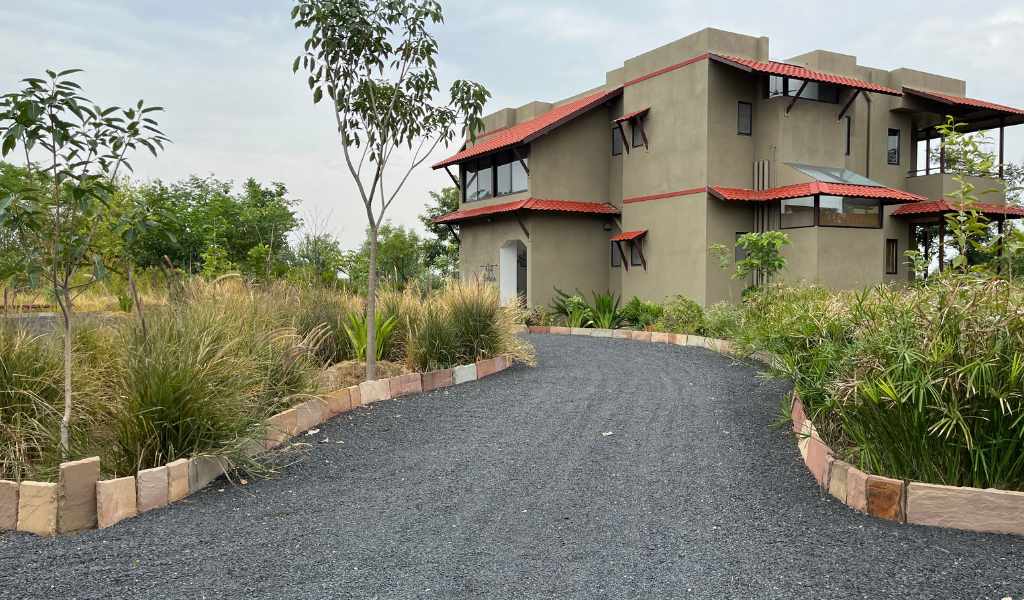
- We were at a cool jungle property – The Jungle Farm in a nearby village, Bordi. If you want an adventure angle to your trip, you could stay at their tree houses and cottages and enjoy the host of nature activities they offer.
What to Shop

A visit to Warli land gives you unique opportunities to bring home not just souvenirs — but living art:
- Original Warli paintings on canvas or paper: Hand-painted by artists from the village – often descendants or disciples of early masters. These are the most authentic pieces.
- Functional Warli crafts: Bags, lampshades, decorative boxes, wall-hangings, clothes decorated with Warli motifs. Many artisans today produce these to sustain their livelihood.
- Custom / commissioned work: You could request a personalised Warli painting – maybe a scene, a theme, a message – and take home something unique.
- Ethical buying – support artists directly: If possible, buy directly from the artist(s) or their families instead of mass-market channels. This helps sustain livelihoods and ensures authenticity (not machine-printed copies).
Reflections from Our Visit
Walking through Handicrafts Week in Delhi, now we see stalls displaying Warli designs on cushions, sarees, and handbags, far from the red-brown village walls where it began. The same paintings that once marked weddings and harvests now appear on canvases, travel across cities, brighten homes and support the artists who create them.
Flashback to Ganjad and Bapugaon, among thatched huts, dusty lanes and open courtyards, we felt Warli not as something old or delicate but as a living art connected to its people. If this story inspires you, or if Handicraft Week makes you curious about folk arts, consider going beyond the exhibition halls. Imagine visiting the villages where the art was born. Make time one day to visit the villages where Warli still plays its flute, beats the drums and dances the ever-evolving dance of life.

Note – Our trip was courtesy banglanatak dot com, a social welfare organisation engaged in inspiring work in the field of crafts and culture development in remote areas and accredited with Advisory status to UNESCO ICH Committee since 2011, in collaboration with Maharashtra Tourism Development Corporation, MTDC.
Do they design clothes?
While we do not recall seeing much clothes here, we have seen Warli art on saris and other pieces of clothing elsewhere
very interesting article! I hadn’t heard about Warli art until now. I hope one day I can see this painting in person.
That is absolutely amazing. I have never heard of Warli art before. It’s such a beautiful artform, and I love the stories it tells. It would be fantastic to visit this village.
It is indeed a walk through beauty
Reading about the Warli art really resonated, especially its simple lines and storytelling. Balancing mum-life and creativity, I admire how this art celebrates everyday life so thoughtfully.
Well-said!
I am not familiar with this type of art; it is a very interesting style. That is neat to be able to see this in person and see where the art is made.
Totally
This was a beautiful read. Warli art truly feels alive, rooted in tradition yet evolving with time. It is more than art. It is history, culture, and storytelling in its purest form.
So true